
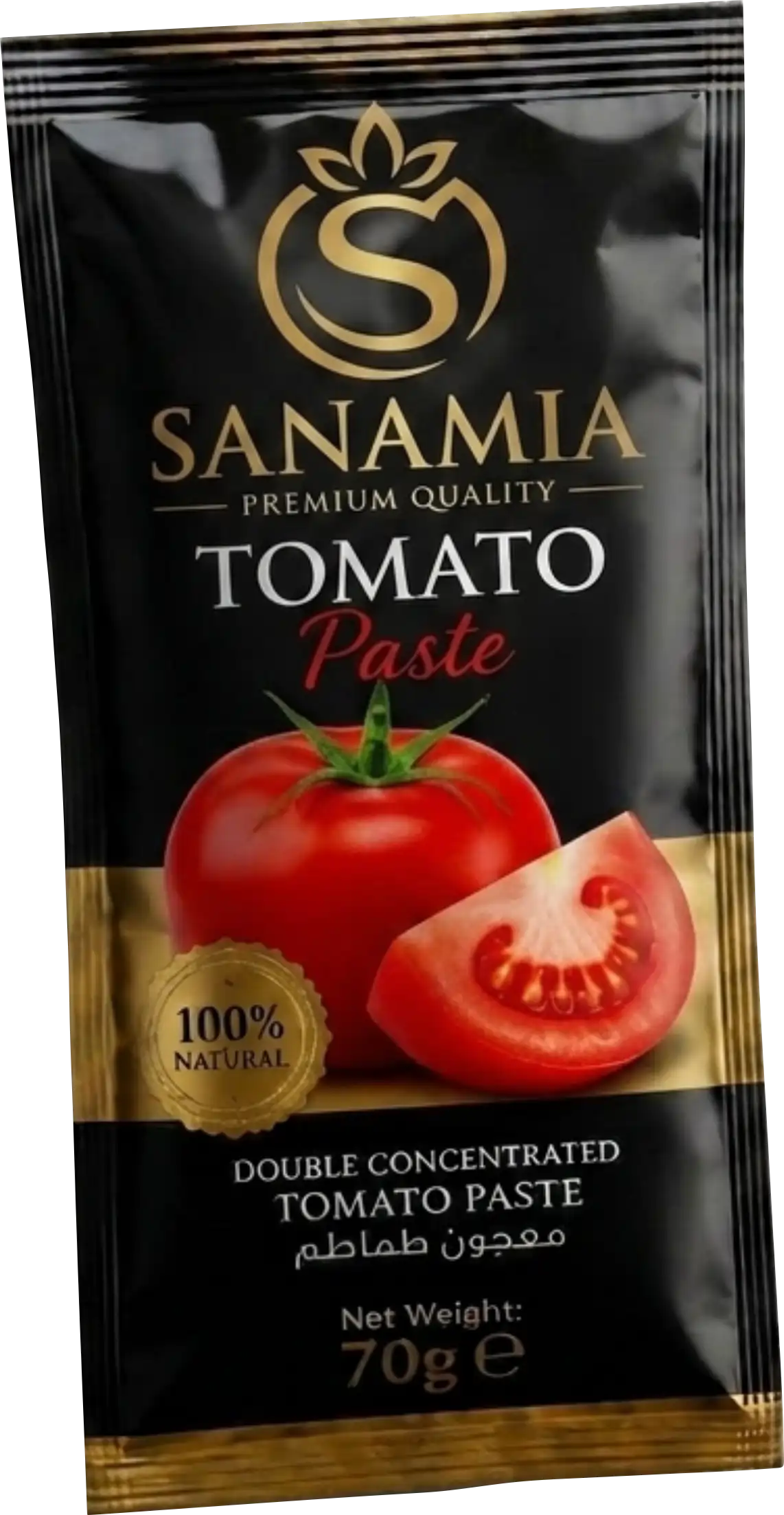
In the hyper-competitive arena of global food commodity trading, the 70g tomato paste sachet has transcended its role as mere packaging; it is now a fundamental strategic asset. For global distributors, wholesale importers, and retail category managers operating in high-growth territories—specifically across Nigeria, Kenya, Afghanistan, and Pakistan—the legacy model of large-format tin distribution is rapidly losing its dominance. The modern market participant requires a supply chain solution centered on accessibility, unit-cost efficiency, and zero-waste inventory management.
At SANAMIA, we have engineered our operations to spearhead this “sachet paradigm,” aligning our manufacturing output with the distinct economic realities of emerging economies. By transitioning our partners toward this high-velocity SKU, we enable them to capture a dominant share of the consumer wallet.
In regions where daily disposable income dictates grocery procurement behaviors, the “sticker price” remains the primary friction point. Large-format 400g or 800g tins often create an insurmountable financial barrier for the average household. Conversely, the 70g sachet offers a low-barrier entry point, aligning perfectly with daily purchasing power.
This strategy capitalizes on the “psychological sweet spot” of volume-based commerce. Integrating SANAMIA’s 70g sachets into your portfolio is not simply about diversifying product offerings; it is about providing a recurring culinary necessity. This fosters high-frequency inventory turnover, creating a resilient, predictable revenue stream that stabilizes the balance sheet for local distributors.
SANAMIA’s strategic focus on the 70g format is driven by the logistical and climate-specific requirements of the African and South Asian markets:
Scaling in these dynamic markets requires balancing aggressive price points with uncompromised product integrity. Consumers in these sectors are highly perceptive; any variance in flavor profile or texture risks immediate brand abandonment.
SANAMIA’s 70g sachet is technically engineered to mitigate these risks. We deploy high-barrier, multi-layer laminate films designed to withstand extreme thermal fluctuations, humidity, and oxidative stress—the critical environmental threats to food quality in tropical and arid zones.
When you partner with SANAMIA, you are procuring more than a commodity; you are securing an assurance of quality. We guarantee that your product will maintain its organoleptic properties—color, viscosity, and natural flavor—from our production line to the final shelf. This is not mere procurement; it is a strategic partnership designed to fortify and scale your operations within the world’s most demanding food markets.
—
Subject: Engineering the 70g Sachet for Global Logistics
In the global B2B landscape, a tomato paste sachet is more than just packaging—it is a critical unit of shelf-life stability. At SANAMIA, our manufacturing process for the 70g SKU is engineered to eliminate variables that compromise quality during transcontinental transit.
#### 1. Aseptic Cold-Break Technology: The Foundation of Integrity
Our production line utilizes advanced Aseptic Cold-Break technology, a process meticulously controlled to preserve the tomato’s native properties. By maintaining lower temperatures during evaporation, we ensure:
#### 2. Advanced Barrier Science: Multi-Layer Protection
The 70g sachet is vulnerable to environmental stressors during long-haul shipping, particularly in tropical climates. To mitigate this, SANAMIA implements:
#### 3. Rigorous Quality Assurance & Regulatory Compliance
We operate on a “Compliance by Design” principle. Every batch of the 70g sachet undergoes exhaustive testing protocols:
*For SANAMIA, quality is not a static goal—it is a measurable, repeatable manufacturing output.*
***
Subject: Export Readiness Beyond the Product Core
In international trade, especially for food ingredients and retail-ready formats, product excellence alone is not enough. Market success depends on whether the supply chain can preserve that excellence across borders, climates, and customs procedures. For SANAMIA, the export model is designed around continuity, traceability, and shipment stability.
The current technical data confirms SANAMIA’s capability in aseptic packaging systems, with high-barrier primary packaging and steel drum secondary protection for bulk formats. This demonstrates a production philosophy built around preservation, contamination control, and long-distance transport reliability.
For buyers, this matters because it signals that SANAMIA operates with:
These are the same structural principles required for smaller retail formats such as 70g sachets, where shelf integrity, sealing performance, and transit resistance become even more critical.
Unlike bulk drums, a 70g sachet is a high-unit, low-weight, retail-distribution format. Its logistics profile is defined not by tonnage efficiency alone, but by:
In practical terms, this means a sachet-based export program must be engineered around:
For importers, the real question is not simply whether the tomato paste is good. The question is whether it can move efficiently through their market structure without quality loss or commercial friction.
SANAMIA’s approach is therefore aligned with three market-entry priorities:
#### a) Distributor Confidence
Importers and agents need predictable supply, stable specifications, and packaging formats that fit their warehouse and retail systems. A product positioned with clear technical identity lowers onboarding friction.
#### b) Climate Adaptability
In hot and humid destination markets, the packaging system must help protect against:
This is especially important for sachets sold through grocery chains, wholesalers, and institutional buyers in regions with high ambient temperatures.
#### c) Channel Flexibility
A 70g sachet is not only a retail SKU; it can also serve:
That flexibility makes the SKU commercially attractive across multiple distribution layers.
A resilient supply chain is one that can absorb variability without interrupting delivery performance. For tomato paste exports, that means:
When these elements are aligned, the product is not merely shipped — it is delivered with its commercial value intact.
SANAMIA’s export readiness should be communicated not as a generic manufacturing claim, but as a system capability:
For B2B buyers, this creates a simple but powerful message:
SANAMIA is not only producing tomato paste; it is delivering a format that is ready for real-world distribution.
—
Subject: Building the Foundation for Collaborative Growth
At SANAMIA, we recognize that the success of our distribution partners depends on more than just the product—it depends on the operational reliability and the flexibility of their supply chain. Our Private Label and Distribution Support framework is engineered to integrate seamlessly into your existing operations, reducing friction from the moment the order is placed until the product hits the shelf.
#### 1. End-to-End Private Label Capability
We treat Private Labeling as a technical extension of your brand, not merely a branding exercise. Our infrastructure supports:
#### 2. Operational Transparency & Regulatory Reliability
For distributors, regulatory compliance is the ultimate risk factor. SANAMIA mitigates this by functioning as an extension of your QC department:
#### 3. Collaborative Distribution Growth
We view our distributors as strategic allies. Our support extends beyond shipping:
*In short, SANAMIA does not just supply tomato paste; we provide a reliable engine that powers your market entry and growth. Our manufacturing expertise is your competitive advantage.*